A New Dawn?
Scientific materialism is de-materialising.
For centuries, the default intellectual framework of the West has been scientific materialism. It’s a 19th-century idea, though it rarely gets described that way: the universe is a dead machine, strictly deterministic, and everything from stars to consciousness reduces to physics and chemistry. Meaning is an illusion. Purpose is something we project onto a cosmos that doesn’t care.
But that framework is losing its grip. Not because people are turning away from reason, but because modern science itself keeps producing findings that don’t fit inside the mechanistic box. The universe turns out to be stranger, more complex, and more suggestive of intention than the materialist model predicted.
What I find interesting is the range of people now pushing back. This isn’t just “Science vs. Religion” anymore. The real question has shifted: is the universe a dead machine, or is it something closer to designed, alive, or conscious?
The forgotten roots of modern science
There’s an irony in the assumption that science and theology are at war. The scientific revolution grew almost entirely out of a Judeo-Christian worldview. Isaac Newton, Johannes Kepler, and James Clerk Maxwell didn’t see their work as rebellion against religion. They believed a rational Creator made a rational universe, and that studying nature was an act of worship. Kepler described his astronomical work as “thinking God’s thoughts after Him.” Materialism took the scientific method but threw out the theological foundation that motivated it in the first place.
The revival of natural theology
The most mainstream academic challenge to materialism today is actually a return to those roots through modernised natural theology. This isn’t dogmatism. It uses modern scientific data to build a logical case for a transcendent Mind.
Oxford mathematical physicist Sir John Polkinghorne and others have argued that the fine-tuning of the universe’s physical constants points to intentionality. If gravity or the electromagnetic force were altered by the slightest fraction, the universe would be uninhabitable. That’s hard to write off as accident.
Some materialists try to explain this away with the multiverse hypothesis: our universe is one of infinitely many, and we just happen to be in the one with the right parameters for life. But there’s a problem with that escape route. Even a theoretical universe-generating mechanism would itself need to be governed by specific mathematical laws to function. You don’t eliminate the need for a designer; you just push it back a step.
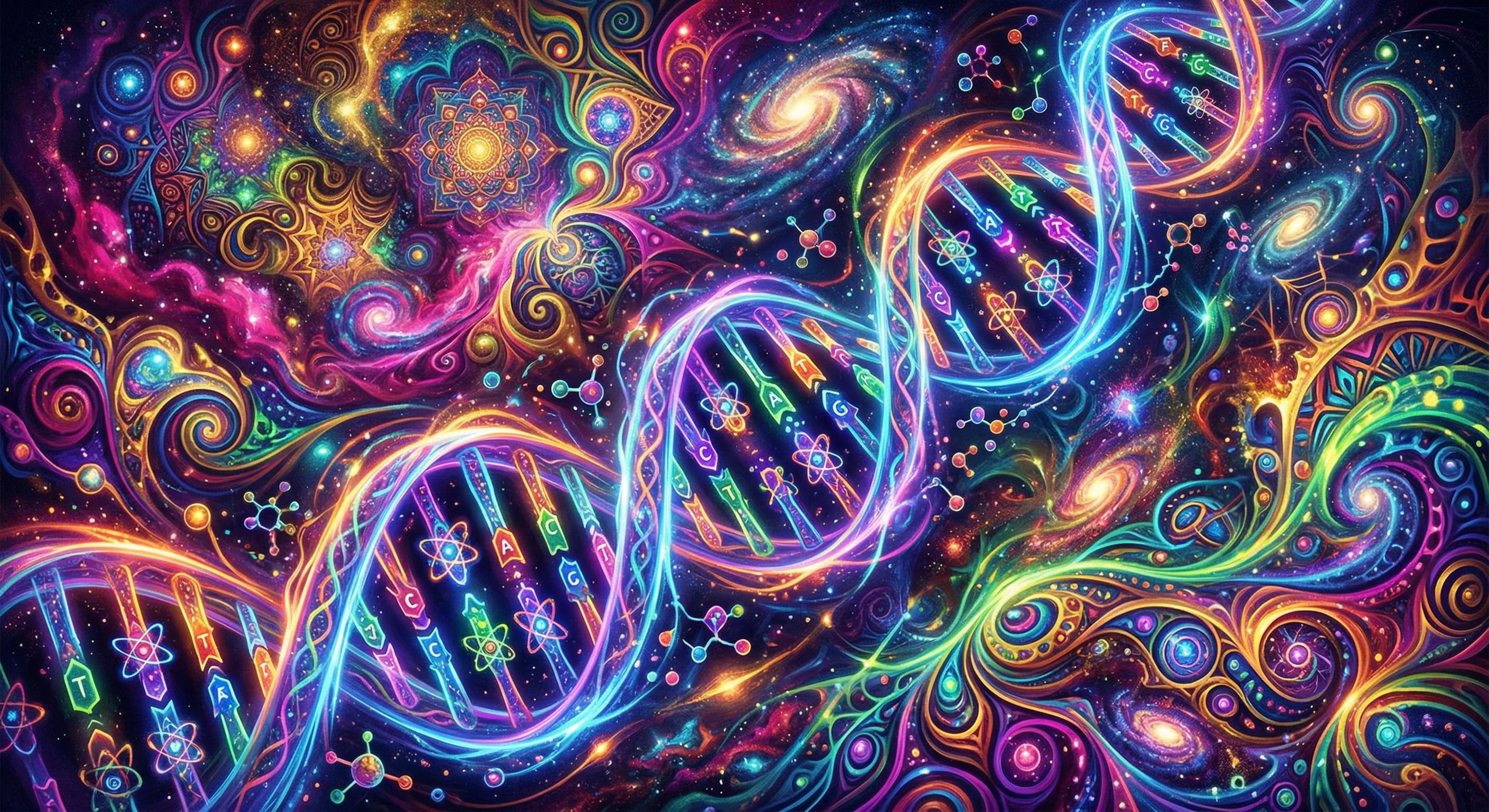
Stephen Meyer, a philosopher of science, takes a different angle. He argues that the digital-like code at the foundation of all life isn’t metaphorical, it’s literal information. The four chemical subunits of DNA function like characters in a text or binary digits in software, arranged in specific sequences that provide instructions for building protein machinery.
His point is about the separation of medium from message. Chemistry explains what holds the DNA molecule together, but it doesn’t dictate how those chemical “letters” are arranged. The properties of ink don’t determine the plot of a novel. The information is carried by the material but isn’t reducible to it. In all our experience, specified functional information comes from a conscious mind, whether a software engineer or an author. Meyer thinks the most rational conclusion is that the code of life points to a prior intelligence rather than unguided physics.
This isn’t just theoretical. Meyer has been involved in establishing the Whewell Centre for Science and Natural Theology in Cambridge, named after the polymath William Whewell. The centre is a hub for scientists and philosophers working to integrate natural sciences with theological frameworks, and placing it in Cambridge feels deliberate.
The cracks in “pure” Darwinian evolution
Maybe the most significant crack in the materialist picture is biological. For decades, neo-Darwinism was the materialist theory of everything for biology: all complexity is the product of random genetic mutations acted upon by natural selection.
That strict mechanism is losing favour among mainstream scientists. The question isn’t whether adaptation occurs, but whether random mutations have the creative power to build fundamentally new animal body plans. Biochemist Michael Behe points to cellular machinery that seems too integrated to have evolved gradually, because the parts only work together.
There’s also the problem of the Cambrian explosion, the sudden appearance of nearly all major animal phyla in the fossil record. That doesn’t look like slow, gradual, incremental change.
These difficulties have led non-theistic evolutionary biologists to form the “Third Way” movement. They acknowledge that random mutation and selection can’t fully account for biological form, and they’re calling for an Extended Evolutionary Synthesis that incorporates non-Darwinian mechanisms. Meanwhile, theologians and philosophers like John Lennox (Emeritus Professor of Mathematics, Oxford), Alister McGrath (Oxford theologian and biophysicist), William Lane Craig, and Alvin Plantinga argue that honest science doesn’t negate the divine. It points toward it.
Biological and cosmic alternatives
Not everyone who rejects materialism moves toward classical theism. Some go somewhere stranger.
Cambridge-trained biologist Rupert Sheldrake rejects both theism and materialism. He argues that biological form doesn’t come from physical laws but from invisible, non-material fields he calls “Morphic Resonance”, a kind of collective memory within nature. Organisms resonate with the habits of their ancestors. Nature isn’t designed by an outside engineer; it’s a living, creative entity that learns. Whether you buy it or not, it’s a genuine attempt to find a third option.
Robert Temple, drawing on the quantum physics of David Bohm, goes in another direction entirely: a kind of cosmic animism. In his framework, intelligence isn’t an immaterial Mind outside the universe but something inherent within matter itself. He argues that 99.9% of the cosmos, which is plasma, possesses its own intelligence, and that the entire universe is something like a conscious neural network.
So what does this mean?
Scientific materialism worked for a long time because it gave simple, mechanistic answers. But it did so by declaring meaning, purpose, and consciousness to be illusions. That bargain is looking increasingly untenable.
What strikes me is how many alternatives are now on the table: designed complexity, living biological habits, cosmic consciousness. The rigid materialist orthodoxy can’t account for reality as we actually observe and experience it. We are not just matter in motion.
The question is no longer whether there’s something more going on, but what kind of something. I don’t think anyone has a complete answer yet. But the conversation has changed, and that matters.